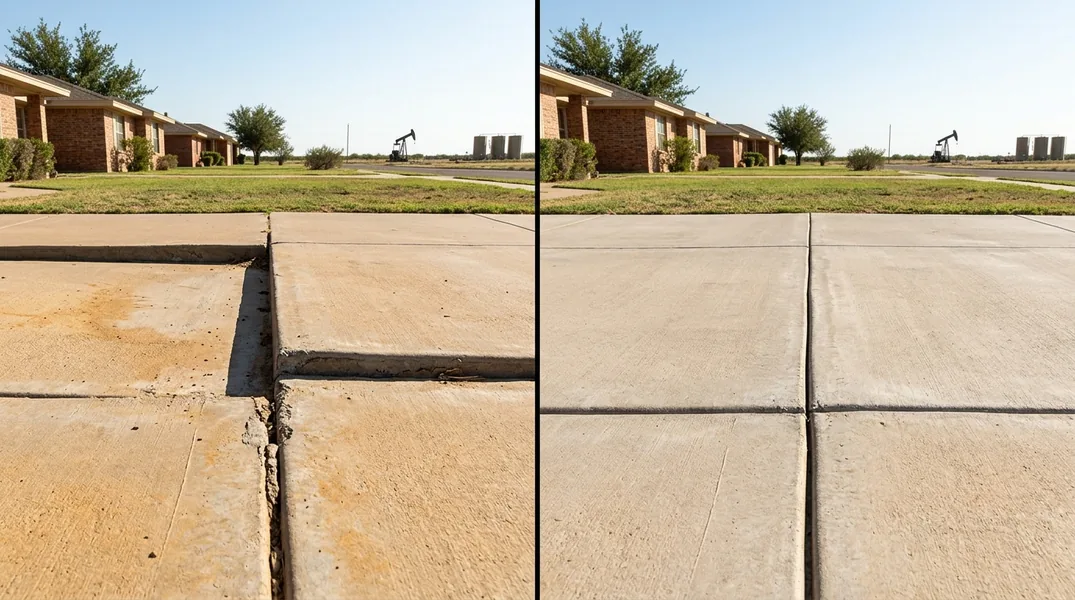
Understanding Odessa's Unique Soil Composition
If you own a home in Odessa, you've likely noticed cracks in your driveway or patio that seem to appear out of nowhere. The culprit isn't always poor installation or cheap materials. More often than not, it's what lies beneath: the region's distinctive caliche and sandy loam soil. These geological features are a defining characteristic of the Permian Basin landscape, and they present unique challenges for concrete installation and longevity.
Caliche is a naturally occurring layer of calcium carbonate that forms in arid climates like ours. It's hard, dense, and essentially impermeable to water. While caliche can provide a stable base in some situations, it also prevents proper drainage and creates a hostile environment for concrete foundations. Sandy loam, on the other hand, is loose and granular, lacking the compaction and stability that concrete needs. When these two soil types exist in close proximity or alternate beneath your property, they create an unstable foundation that shifts and moves with seasonal changes in moisture and temperature.
How Caliche Soil Causes Concrete Cracking in Odessa, Texas
Caliche's impermeable nature is the primary reason Odessa homeowners experience persistent concrete cracking. When rain falls on a concrete slab built over caliche, water cannot penetrate the caliche layer and drain away naturally. Instead, it pools beneath the concrete, creating hydrostatic pressure that pushes upward against the slab. This pressure builds over time, especially during our wet season, and forces the concrete to heave and crack. The pressure is relentless and powerful enough to break even well-installed concrete.
Additionally, caliche is prone to dissolution in the presence of acidic water. Rainwater and groundwater naturally contain carbonic acid, which slowly eats away at the calcium carbonate structure. This dissolution creates voids and weak points beneath your concrete surface. As these voids expand, the concrete above loses support and begins to settle unevenly. The result is a pattern of cracks that radiate across your Concrete Driveway, often starting at the edges and working inward. Many homeowners mistake this for a defect in the concrete itself, when the real problem lies in the soil beneath.
Clay Pockets and Slab Movement: A Hidden Problem
Beneath the surface of many properties in Odessa, hidden clay pockets create an additional layer of complexity. These pockets of clay are often trapped between layers of caliche and sandy loam, creating a sandwich-like structure. Clay is highly expansive, meaning it swells dramatically when it absorbs moisture and shrinks when it dries out. This expansion and contraction cycle is one of the most destructive forces acting on concrete slabs in our region.
During the rainy season, clay pockets absorb water and expand, pushing the concrete slab upward. This upward movement, called heave, can be several inches over the course of a season. When the dry season arrives, the clay shrinks back down, and the concrete settles. This constant up-and-down movement creates stress on the concrete, eventually leading to cracking, buckling, and uneven surfaces. The damage accumulates year after year, transforming what started as a hairline crack into a major structural problem. Homeowners often don't realize that slab movement is occurring until the damage becomes visible and severe.
Why Sandy Loam Fails as a Concrete Foundation
Sandy loam, while easier to excavate and prepare than caliche, offers poor support for concrete structures. This soil type lacks the density and cohesion needed to distribute the weight of concrete evenly. When a concrete slab is poured directly on sandy loam without proper preparation, the soil compacts unevenly under the weight of the slab and any vehicles or foot traffic on top of it. This differential settling causes one section of the concrete to sink slightly lower than an adjacent section, creating stress concentrations at the boundaries.
Sandy loam is also highly susceptible to erosion and washout, particularly in areas where water drainage is poor. Heavy rains or irrigation runoff can wash away the sandy soil from beneath the concrete, creating voids that cause the slab to crack and settle. Additionally, sandy loam does not retain moisture well, which means it can shift and compact differently depending on seasonal moisture levels. Professional concrete contractors in Odessa know that sandy loam requires a substantial gravel base layer and proper compaction before any concrete can be safely installed.
Prevention and Solutions: Protecting Your Concrete Investment
The good news is that understanding Odessa's soil challenges allows us to design concrete solutions that actually last. Proper site preparation is the foundation of any successful concrete project in our region. This begins with removing the top layer of caliche and sandy loam and replacing it with compacted gravel or recycled asphalt, which provides a stable, well-draining base. Professional contractors also install a moisture barrier beneath the concrete to prevent water from pooling and creating hydrostatic pressure.
Reinforcement is another critical component. Steel rebar or wire mesh embedded in the concrete helps distribute stress and prevents cracks from spreading. For properties with known clay pockets or severe caliche layers, a thickened concrete slab (often 5 to 6 inches instead of the standard 4 inches) provides additional strength and durability. Proper slope and drainage design ensure that water runs off the surface rather than collecting beneath it. When these best practices are followed, Concrete Driveways and Concrete Patios in Odessa can perform reliably for 20 years or more, even in our challenging soil conditions.
When to Call a Professional for Concrete Repair Near Me
If you're already seeing cracks in your driveway or noticing that your patio is settling unevenly, it's time to call a professional. Early intervention can often prevent minor damage from becoming a major expense. A qualified contractor can assess your soil conditions, identify the underlying cause of the damage, and recommend the most cost-effective repair strategy. Sometimes a simple Concrete Repair & Resurfacing solution is sufficient. In other cases, addressing the soil problem is necessary to prevent the damage from recurring.
Odessa Concrete Pros specializes in diagnosing and solving soil-related concrete problems throughout the region. Our team understands the specific challenges posed by caliche, sandy loam, and clay pockets because we work with these soil types every day. We can provide a detailed assessment of your property and recommend solutions tailored to your specific situation. Whether you need a simple crack repair or a complete driveway replacement with proper soil preparation, we're here to help. Call us at (432) 614-3668 or visit our website to request a free estimate today. Don't let Odessa's soil conditions damage your concrete investment any longer.
Looking for a professional concrete contractor in Odessa? Odessa Concrete Pros responds fast for all your concrete needs.
Get a Free QuoteOur services: Concrete Driveways · Concrete Patios · Stamped & Decorative Concrete